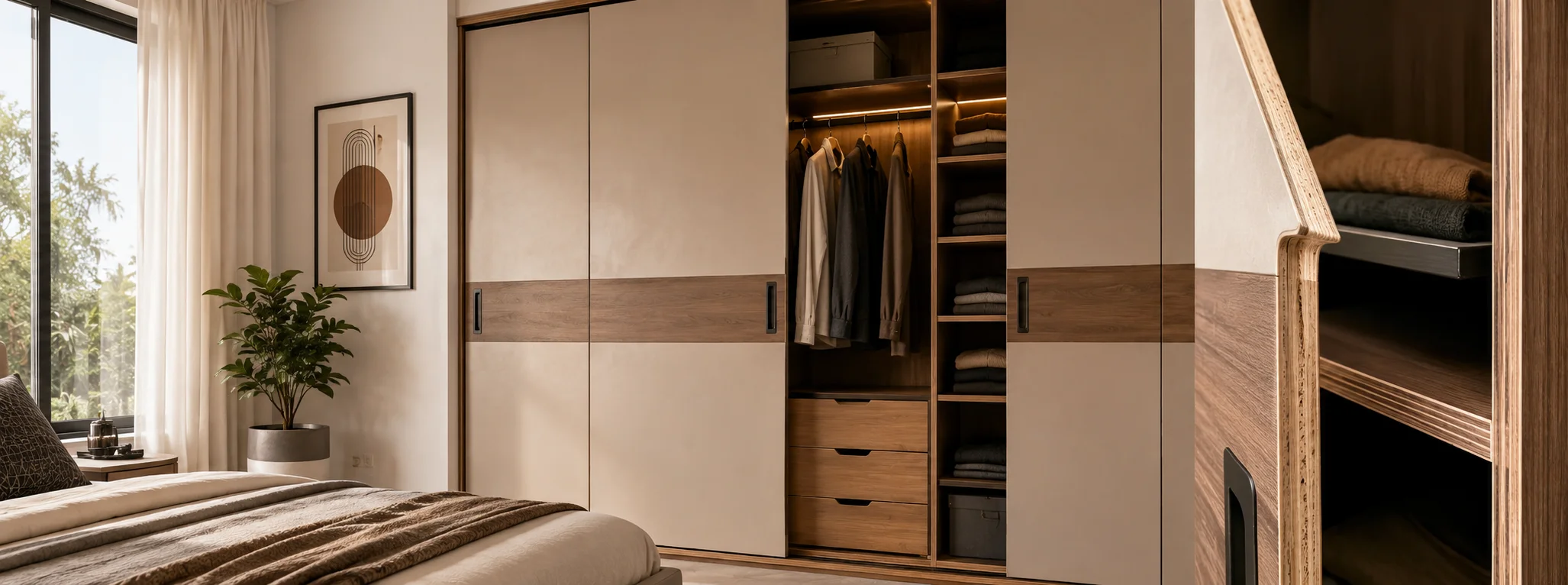
Best Plywood for Wardrobe in India: How to Choose the Right Grade, Thickness and Quality
Choosing the best plywood for a wardrobe is about more than thickness or price. The right sheet depends on where the wardrobe will be installed, how much moisture the room receives, the load on shelves, the size of the shutters and the hardware used in construction.
For a relatively dry bedroom, MR plywood may be a practical choice. In a more humid environment, BWR plywood can offer greater water resistance. Where higher moisture resistance matters, BWP plywood may be worth considering. For many wardrobe carcasses, shelves and partitions, 18mm plywood is commonly used, although the ideal thickness still depends on span, load and design.
In short, choose the plywood grade according to the room conditions, then select thickness and construction details according to the job each wardrobe component has to perform.
What Is Plywood?
Plywood is an engineered wood panel made by bonding several layers of wood veneer together. Manufacturers generally arrange adjoining veneer layers in different grain directions. This construction helps the panel achieve useful strength and dimensional stability.
Unlike a solid timber board, plywood comes as a manufactured panel in standard thicknesses and sheet sizes. Furniture makers can cut, drill and finish it according to the wardrobe design.
Depending on the design, plywood can form several parts of a wardrobe, including:
- Side panels
- Top and bottom panels
- Vertical partitions
- Shelves
- Wardrobe shutters
- Drawer components
- Internal storage sections
- Plinths and supports
- Back panels, where the design calls for them
Still, plywood alone does not determine how long a wardrobe will last. The joints, hardware, edge protection, surface finish, fabrication and installation all influence the finished furniture.
If you are also comparing plywood for other furniture and interior applications, see our plywood selection guide for furniture.
Which Plywood Is Best for a Wardrobe?
The best plywood for a wardrobe depends mainly on the environment in which the furniture will sit.
A bedroom that stays relatively dry may not need the highest water-resistance grade. In such a setting, MR plywood can offer a practical balance between performance and cost.
Humidity changes the equation. For rooms that experience greater moisture, BWR plywood can be considered because it provides a higher level of water resistance than MR plywood.
Where the project calls for still greater water resistance, BWP plywood may be appropriate. However, the highest water-resistance grade is not automatically the best choice for every wardrobe.
It is also worth remembering that MR, BWR and BWP mainly describe moisture and water-resistance characteristics. They should not be treated as a simple ranking of overall plywood strength.
Thickness, core construction, bonding quality, bending performance, workmanship and compliance with the applicable standard also affect performance.
MR vs BWR vs BWP Plywood for Wardrobe
| Feature | MR Plywood | BWR Plywood | BWP Plywood |
|---|---|---|---|
| Full form | Moisture Resistant | Boiling Water Resistant | Boiling Water Proof |
| Water/moisture resistance | Suitable for lower-moisture indoor conditions | Higher water resistance than MR | Higher water resistance than BWR |
| Dry bedroom wardrobe | Can be sufficient | Suitable | Suitable |
| Humid conditions | Less suitable | More suitable | More suitable |
| Higher moisture exposure | Not the preferred choice | Can be considered | More appropriate |
| Relative cost | Usually more economical | Usually higher than MR | Usually higher than MR |
| Wardrobe application | Yes, depending on conditions | Yes | Yes |
These categories provide a practical starting point rather than a universal rule. Before buying, check the manufacturer’s technical specifications and the applicable certification for the exact product.
MR Plywood for Wardrobe
MR plywood for wardrobe applications can work well in relatively dry indoor spaces.
MR stands for Moisture Resistant. Manufacturers commonly use this grade for furniture that does not face significant water or dampness.
For example, a bedroom wardrobe in a well-ventilated and reasonably dry room may not need a higher water-resistance grade.
Advantages of MR Plywood
- Suitable for many dry indoor applications
- Can provide a cost-conscious option
- Available in common furniture thicknesses
- Works with laminates and veneers
- Suitable for many standard wardrobe designs
When Should You Choose MR Plywood?
MR plywood makes sense when significant moisture exposure is unlikely. It can also suit projects where controlling the material budget matters.
However, consistently humid homes may benefit from a plywood grade with greater water resistance. In that case, BWR or BWP can be considered after reviewing the actual site conditions.
BWR Plywood for Wardrobe
BWR plywood for wardrobe applications becomes more relevant when humidity and occasional moisture are greater concerns.
BWR stands for Boiling Water Resistant. Compared with MR plywood, this grade provides a higher level of water resistance.
As a result, BWR can be considered for wardrobes in:
- Humid homes
- High-humidity regions
- Rooms with greater moisture exposure
- Projects where additional moisture resistance is preferred
Even so, BWR plywood should not be treated as immune to water. Proper edge protection, finishing and installation remain important.
BWP Plywood for Wardrobe
BWP plywood for wardrobe applications can make sense when higher water resistance is an important project requirement.
BWP stands for Boiling Water Proof. It is generally considered when a project requires a higher level of water resistance than a standard MR application.
BWP may therefore suit wardrobes installed in highly humid environments or projects where additional water resistance justifies the additional material cost.
That higher specification can also increase the overall cost. Therefore, BWP is not automatically the most economical or practical choice for every bedroom wardrobe.
Is BWP Plywood Always the Best for a Wardrobe?
No. The highest water-resistance grade does not automatically make the best wardrobe.
A wardrobe in a dry bedroom may have very little contact with moisture. In that situation, paying extra for a higher water-resistance grade may offer limited practical benefit.
On the other hand, a humid environment can justify a plywood grade with greater water resistance.
- Dry room: MR may be sufficient.
- Humid room: BWR can be considered.
- Higher moisture exposure: BWP may be considered.
The final choice should reflect the actual room conditions, product specifications and construction requirements.
What Plywood Thickness Is Best for a Wardrobe?
Plywood thickness for wardrobe construction should follow the function of each component rather than a one-size-fits-all rule.
For many structural wardrobe parts, 18mm plywood is a common choice. It provides useful rigidity and works with many furniture hardware systems.
However, a wardrobe does not need the same thickness for every part. Shelves, shutters, drawers and back panels perform different jobs and experience different loads.
For a broader understanding of plywood choices for residential interiors, you can also explore our guide to the best plywood for home interiors.
Is 18mm Plywood Good for a Wardrobe?
Yes. 18mm plywood is commonly used for wardrobe carcasses, shelves, partitions and shutters where a substantial panel is required.
- Good rigidity
- Useful structural strength
- Compatibility with common furniture hardware
- Good screw-fixing characteristics when correctly designed
- Compatibility with laminates and veneers
Nevertheless, thickness alone does not determine performance. Shelf span, load, support spacing, plywood construction and hardware all affect how the finished wardrobe behaves.
Recommended Plywood Thickness for Different Wardrobe Parts
| Wardrobe Component | Common Thickness Consideration |
|---|---|
| Main carcass | 18mm is commonly considered |
| Vertical partitions | 18mm is commonly considered |
| Shelves | 18mm is commonly considered |
| Long or heavy-duty shelves | 18mm or more, depending on span and support |
| Wardrobe shutters | Often 18mm, depending on size and design |
| Drawer components | 12–18mm, depending on the component |
| Back panel | 6–9mm or according to the design |
These figures are practical furniture-design ranges rather than universal structural specifications. Large panels, heavy loads and long unsupported spans deserve a component-specific review before fabrication.
Why Shelf Span Matters as Much as Thickness
A common mistake is to judge a wardrobe shelf only by its thickness. In practice, the unsupported length can matter just as much.
Every shelf needs to resist bending under its own weight and the items placed on it. As the unsupported span grows, deflection can become more noticeable even when the plywood thickness remains unchanged.
For instance, an 18mm shelf with a short span can behave very differently from an 18mm shelf that stretches across a wide compartment and carries heavy storage.
A useful way to think about shelf performance is:
Thickness + span + support spacing + load + plywood stiffness
That is why the question “Is 18mm plywood strong enough?” needs more information about the shelf dimensions and expected load.
How to Prevent Wardrobe Shelves from Sagging
- Reduce the unsupported shelf span
- Add a vertical partition where appropriate
- Increase thickness if the design requires it
- Add a suitable front stiffening strip
- Provide additional support points
- Distribute heavy items across several shelves
- Avoid overloading individual shelves
Folded clothes usually weigh less than books, luggage, tools or dense storage boxes. Therefore, consider the actual load before finalising shelf dimensions.
Best Plywood for Wardrobe Doors
Wardrobe doors experience repeated movement. Every opening and closing cycle transfers loads through the hinges, screws, mounting plates and cabinet sides.
When choosing plywood for wardrobe doors, consider:
- Door height
- Door width
- Panel thickness
- Door weight
- Hinge type
- Number and position of hinges
- Surface finish
- Edge treatment
- Overall cabinet construction
Large shutters deserve particular attention because their weight places greater demands on hinges and fixing points.
Can 18mm Plywood Be Used for Wardrobe Doors?
Yes. 18mm plywood is commonly considered for wardrobe shutters where a substantial and stable panel is required.
However, large doors should not rely on thickness alone. The finished shutter weight affects the hinges, screws, mounting plates and cabinet sides.
A more useful approach is to consider:
Panel size + panel weight + hinge capacity + number of hinges + fixing quality + cabinet construction
For unusually tall or wide shutters, follow the hardware manufacturer’s load and installation recommendations.
Best Plywood for Wardrobe Shelves
The best plywood for wardrobe shelves depends on both plywood quality and shelf design.
1. Shelf Thickness
Greater thickness generally increases stiffness. This becomes especially useful when a shelf has a long span or carries a higher load.
2. Shelf Length
Long shelves need more support because deflection generally increases as the unsupported span becomes larger.
3. Expected Load
Folded clothes create a different load from books, shoes, bags or storage boxes. Consider what the wardrobe will actually hold.
4. Support Arrangement
A shelf supported at several points behaves differently from one supported only at its ends.
5. Core Construction
A well-manufactured plywood panel with consistent bonding and a sound core can provide more reliable performance than a poorly manufactured panel with the same nominal thickness.
What Is the Best Plywood for a Heavy-Duty Wardrobe?
A heavy-duty wardrobe needs more than a strong plywood sheet. The entire furniture system has to work together.
- Good-quality plywood
- Suitable thickness
- Correct shelf support
- Strong joints
- Proper screw fixing
- Suitable hinges
- Appropriate drawer hardware
- Good edge protection
- Correct installation
If the wardrobe will carry unusually heavy loads, review the dimensions and support structure before fabrication.
How to Check Plywood Quality Before Buying
1. Check the Thickness
Where practical, check the sheet thickness and look for consistency.
2. Inspect the Edge
Look at the exposed edge of the plywood. The veneer layers should appear reasonably consistent and properly bonded.
3. Check the Surface
Look for excessive patches, cracks, open defects, blisters, uneven areas or other visible manufacturing issues.
4. Check Product Markings
Look for manufacturer identification, product grade and relevant standard or certification information.
5. Ask for Documentation
Technical specifications provide more useful information than broad claims such as “premium plywood” or “super strong plywood.”
For the available plywood range and product categories, you can also visit our plywood collection.
Why Plywood Core Quality Matters
Two plywood sheets can have the same thickness and still perform differently.
Veneer quality, core construction, bonding, number of plies, manufacturing consistency and internal gaps can all affect performance.
The decorative face veneer therefore does not tell you everything about the structural quality of the sheet.
What Does BIS Certification Mean for Wardrobe Plywood?
For buyers in India, checking the applicable Indian Standard can make product comparison more reliable.
IS 303:2024 – Plywood for General Purposes – Specification is the relevant BIS standard for general-purpose plywood. It covers MR, BWR and BWP grades and includes requirements related to construction, dimensions, water resistance, bending performance, workmanship and formaldehyde requirements.
For that reason, buyers should look beyond marketing terms such as “premium,” “strong” or “waterproof.”
- Plywood grade
- Applicable Indian Standard
- BIS certification information
- Technical specifications
- Product application information
- Warranty or supporting documentation, where available
Does Wardrobe Plywood Need Termite Resistance?
Termites can damage wood-based furniture, particularly in conditions that support termite activity. For that reason, termite-related treatment or performance can be an important consideration when selecting wardrobe plywood.
However, termite protection does not replace good construction. Moisture control, proper installation and regular inspection still matter.
Ask the manufacturer whether the specific product has termite treatment, testing or a defined performance claim. Supporting documentation is preferable to an unsupported marketing statement.
Moisture Resistance vs Waterproofing: What Is the Difference?
The word “waterproof” can become misleading when used without context.
Water-resistant plywood provides resistance under specified conditions. That does not mean a finished wardrobe can remain exposed to standing water or uncontrolled moisture without risk.
- Edges remain unprotected
- Water enters through joints
- Moisture becomes trapped behind the wardrobe
- The wall itself is damp
- The room remains persistently humid
- Finishing or installation is poor
Good wardrobe construction therefore combines a suitable plywood grade with proper finishing, edge protection and moisture management.
Why Edge Sealing Is Important in a Plywood Wardrobe
Plywood edges expose the ends of multiple veneer layers. These areas deserve attention because poorly protected edges can be more vulnerable to moisture entry.
- Edge banding
- Suitable sealants
- Laminate wrapping
- Paint or coating systems
- Proper joint detailing
Is Marine Plywood Necessary for a Wardrobe?
Usually, no. A normal bedroom wardrobe does not automatically require marine plywood.
Marine plywood falls under IS 710:2024 – Marine Plywood – Specification. It is intended for applications where the characteristics associated with marine plywood are actually required.
For a typical indoor wardrobe, a suitable general-purpose plywood grade under IS 303:2024 may be sufficient.
Plywood vs MDF for Wardrobes
Plywood and MDF have different characteristics, so the better choice depends on the wardrobe design, environment and desired finish.
Plywood
- Good structural performance
- Useful strength-to-weight characteristics
- Suitable for many load-bearing furniture components
- Good screw-fixing performance when correctly designed
- Available in different moisture-resistance grades
MDF
- Smooth and uniform surface
- Excellent for many painted finishes
- Easy to machine
- Consistent surface texture
For structural wardrobe construction, plywood often makes sense when strength, durability and moisture resistance are priorities. MDF can still work well for selected designs where a smooth painted finish matters most.
Plywood vs Particle Board for Wardrobes
Particle board can provide an economical furniture solution and remains common in factory-made wardrobes.
Plywood may be preferable when the project places greater importance on structural strength, screw fixing, moisture resistance or long-term durability.
Particle board can still make sense when cost is the main consideration and the furniture will remain in controlled indoor conditions.
How Humidity Affects Wardrobe Plywood
Wood-based panels respond to changes in surrounding moisture. Plywood is relatively dimensionally stable, but it can still absorb and release moisture.
For a broader guide to how Indian climate conditions can affect plywood selection and performance, see our article on the best plywood for the Indian climate.
- Dimensional movement
- Edge swelling
- Finish problems
- Joint stress
- Warping in poorly designed panels
- Reduced durability under severe exposure
Humidity becomes particularly relevant in coastal and high-humidity parts of India. In those conditions, consider plywood grade, edge protection, ventilation and installation together.
Does Plywood Warp?
Plywood is generally dimensionally stable, but it is not completely immune to movement or deformation.
- Moisture imbalance
- Poor storage
- Improper installation
- Uneven finishing
- Large unsupported panels
- Internal stresses
- Poor-quality construction
- Incorrect hardware installation
How to Store Plywood Before Making a Wardrobe
- Store sheets flat and properly supported
- Keep them away from standing water
- Protect them from rain
- Avoid unnecessary exposure to excessive humidity
- Do not place heavy objects unevenly on the sheets
- Allow appropriate acclimatisation where site conditions require it
Best Plywood for Wardrobe in Different Indian Climates
Indian homes experience very different humidity and moisture conditions. The plywood grade should therefore be selected according to the actual installation environment rather than using the same specification everywhere.
Dry Climate
For a relatively dry indoor bedroom, MR plywood may be considered when the product meets the required quality and certification requirements.
Humid Climate
In humid indoor conditions, BWR can provide an additional level of water resistance and may be a practical consideration.
High Moisture Exposure
Where moisture exposure is significantly higher, BWP can be considered if its additional water resistance matches the application requirement.
Coastal Areas
Coastal homes often need a broader moisture-management approach. Plywood grade, edge protection, ventilation and suitable hardware should work together.
How Much Plywood Is Needed for a Wardrobe?
The amount of plywood required depends on the wardrobe design rather than its external dimensions alone.
- Height
- Width
- Depth
- Number of compartments
- Number of shelves
- Number of drawers
- Number of shutters
- Back panel arrangement
- Vertical partitions
- Plinth design
- Additional storage sections
The most reliable approach is to prepare a component-wise cutting list before purchasing the sheets.
How to Calculate Plywood Requirement for a Wardrobe
A carpenter or furniture manufacturer generally prepares a cutting list based on the final design.
- Side panels × 2
- Top panel × 1
- Bottom panel × 1
- Vertical partitions × required quantity
- Shelves × required quantity
- Drawers × required quantity
- Shutters × required quantity
- Back panels × required quantity
Each component can then be mapped onto standard sheet sizes while allowing for cutting losses and wastage.
How Plywood Thickness Affects Wardrobe Cost
Thicker plywood generally increases material consumption, weight and cost.
Using 18mm plywood throughout the wardrobe can create a substantial structure, but that approach may not always offer the best value.
A well-designed wardrobe therefore uses material according to function instead of automatically applying the same thickness everywhere.
How to Choose Plywood for Different Wardrobe Components
The right plywood specification can vary between the carcass, shelves, shutters, drawers and other wardrobe components.
These selection principles also apply to other furniture applications. You can explore our complete plywood selection guide for furniture for broader guidance on choosing plywood for different furniture requirements.
| Component | Main Considerations |
|---|---|
| Carcass | Strength, stability and thickness |
| Shelves | Thickness, span, load and support |
| Doors | Weight, size, hinges and stability |
| Drawers | Thickness, hardware and load |
| Partitions | Rigidity and fixing |
| Back panel | Stability, thickness and design |
| Edges | Moisture protection and finishing |
| Decorative panels | Surface quality and finish compatibility |
Best Plywood for Wardrobe with Laminates
If the wardrobe will receive a laminate finish, the plywood surface should be reasonably flat, clean and compatible with the selected adhesive and application method.
The finished appearance depends on the complete finishing system:
Plywood + adhesive + laminate + edge treatment + workmanship
You can explore laminates for interior applications when selecting colours, patterns and finishes for a wardrobe.
Plywood and Veneer for a Premium Wardrobe
Veneer can be a good option when the goal is to create a natural wood appearance.
In this construction, plywood provides the structural substrate while veneer creates the visible wood surface.
You can explore wood veneers for interior applications when planning a premium wardrobe.
Why Wardrobe Hardware Matters as Much as Plywood
A wardrobe works as a complete system. Good plywood cannot compensate for hardware that does not match the design or load.
- Hinges
- Drawer channels
- Handles
- Sliding mechanisms
- Shelf supports
- Lift-up mechanisms
- Connectors
- Screws
- Mounting plates
You can also explore architectural hardware for interior projects when planning a complete wardrobe system.
How Many Hinges Does a Wardrobe Door Need?
There is no single hinge count that works for every wardrobe door.
The required number depends on door height, width, weight, material, hinge type and manufacturer recommendations.
How to Make a Plywood Wardrobe Last Longer
1. Control Moisture
Keep the wardrobe away from prolonged water exposure and persistent dampness.
2. Protect Exposed Edges
Use suitable edge treatment wherever plywood remains exposed.
3. Choose Appropriate Hardware
Hinges, drawer systems and connectors should match the expected loads.
4. Support Long Shelves
Do not leave long, heavily loaded shelves without adequate support.
5. Avoid Overloading
Distribute heavy items instead of concentrating them on one shelf.
6. Install the Wardrobe Correctly
Proper alignment can reduce unnecessary stress on doors, hinges and joints.
7. Maintain Ventilation
Good ventilation can help when a wardrobe sits against a wall in a humid environment.
8. Inspect the Furniture
Periodically check for loose screws, sagging shelves, swollen edges, delamination, hardware movement, moisture marks and termite activity.
Common Mistakes When Buying Plywood for a Wardrobe
Choosing Only by Price
The cheapest plywood may not provide the best long-term value. Compare grade, construction, certification and technical specifications as well.
Assuming BWP Is Always Necessary
Higher water resistance helps when the environment requires it. A dry bedroom may not need the highest grade.
Using One Thickness Everywhere
Wardrobe components have different structural requirements.
Ignoring Shelf Span
A thick shelf can still deflect when its unsupported span becomes excessive.
Ignoring Core Quality
The face veneer alone does not tell you how the internal construction will perform.
Ignoring Hardware
Doors and drawers depend heavily on correctly selected and installed hardware.
Ignoring Edges
Exposed edges need suitable protection, particularly in humid environments.
Buying Without Checking Standards
Ask for applicable standards, certification information and technical specifications.
Treating “Waterproof” as “Immune to Water”
Even water-resistant plywood should not face uncontrolled and prolonged water exposure.
Questions to Ask Your Plywood Supplier
- What plywood grade is this?
- Is it MR, BWR or BWP?
- Which Indian Standard applies to the product?
- Is the product covered by BIS certification?
- What is the stated thickness?
- What type of core construction does it have?
- Does the product have termite-related treatment or performance claims?
- What formaldehyde class applies?
- What applications does the manufacturer recommend?
- What technical documentation and warranty are available?
A Simple Step-by-Step Guide to Choosing Wardrobe Plywood
Step 1: Understand the Environment
First, determine whether the wardrobe will sit in a dry room, humid room or moisture-prone area.
Step 2: Choose the Plywood Grade
Consider MR, BWR or BWP according to moisture conditions and the exact product specifications.
Step 3: Decide the Thickness
Select thickness according to the individual component instead of automatically using one thickness throughout.
Step 4: Estimate the Load
Think about what the wardrobe will actually store.
Step 5: Check Plywood Construction
Inspect the edge, bonding, thickness consistency and visible core quality.
Step 6: Verify Standards
Check the applicable BIS standard and product certification information.
Step 7: Consider Termite Protection
Ask the manufacturer for specific treatment or performance information.
Step 8: Select the Finish
Choose laminate, veneer, paint or another finish according to the desired appearance and maintenance requirements.
Step 9: Match the Hardware
Hinges, drawer systems and other hardware should match the dimensions and expected loads.
Step 10: Focus on Fabrication and Installation
Good plywood can still perform poorly when cutting, joints, fixing or installation are not handled correctly.
Best Plywood for Wardrobe: Quick Recommendation
| Situation | Practical Choice |
|---|---|
| Dry bedroom | MR plywood may be sufficient |
| Humid bedroom | BWR can be considered |
| Higher moisture exposure | BWP may be considered |
| Typical structural components | 18mm is commonly considered |
| Long heavy shelves | Evaluate thickness and support together |
| Large shutters | Consider panel weight, hinges and fixing quality |
Frequently Asked Questions About Plywood for Wardrobes
Which plywood is best for a wardrobe?
The best plywood depends on moisture exposure, wardrobe design, expected load, thickness requirements and budget. MR, BWR and BWP can all work in different situations.
Which is better for a wardrobe, MR or BWR plywood?
MR can suit a relatively dry bedroom. BWR becomes worth considering when the room has higher humidity or greater moisture exposure.
Is BWP plywood good for wardrobes?
Yes. BWP can be suitable when higher water resistance is required. However, every bedroom wardrobe does not necessarily need it.
Is 18mm plywood good for a wardrobe?
Yes. 18mm plywood is commonly considered for structural wardrobe components such as carcasses, partitions and shelves. The final thickness should still reflect span, load and construction.
Which plywood is best for wardrobe shelves?
A good-quality plywood with suitable thickness and adequate support can work well for shelves. Shelf span and expected load matter just as much as thickness.
Which plywood is best for wardrobe doors?
The plywood should have suitable thickness and stability for the door dimensions. Hinge capacity, fixing quality and overall shutter weight also deserve attention.
Is waterproof plywood necessary for a wardrobe?
Not always. A dry bedroom may not require the highest water-resistance grade. Higher moisture resistance becomes more relevant when the wardrobe faces humid or moisture-prone conditions.
Does wardrobe plywood need termite resistance?
Termite protection can be useful where termite activity is a concern. Ask the manufacturer for specific treatment, testing or performance information.
Can MR plywood be used in a humid area?
It depends on the actual environment and product specification. When humidity and moisture exposure are significant, BWR or BWP may be more appropriate.
Can plywood warp inside a wardrobe?
Plywood is generally dimensionally stable, but moisture imbalance, poor storage, unsupported panels, incorrect installation and poor construction can contribute to deformation.
How thick should plywood be for wardrobe shelves?
18mm is commonly considered for many wardrobe shelves. However, shelf span, load and support spacing should also be evaluated before finalising the thickness.
Is marine plywood required for a bedroom wardrobe?
Usually not. A suitable general-purpose plywood grade can be sufficient for normal indoor wardrobes. Marine plywood should be selected when its specific characteristics are actually required.
How can I make my plywood wardrobe last longer?
Choose suitable plywood, protect exposed edges, control moisture, use appropriate hardware, provide adequate shelf support and ensure proper fabrication and installation.
Final Takeaway
Choosing the best plywood for a wardrobe does not mean automatically buying the thickest or most expensive sheet. The better approach is to match the material to the environment and the job each component needs to perform.
A durable wardrobe brings several decisions together:
Right plywood grade + suitable thickness + good core construction + moisture protection + appropriate hardware + adequate support + proper installation
For a dry bedroom, MR plywood can be a practical option. More humid conditions may justify BWR, while higher moisture exposure can make BWP worth considering.
For many structural wardrobe components, 18mm plywood is commonly used. Shelves, shutters, drawers and back panels should still be specified according to their individual requirements.
Choose plywood according to the environment, load and function—not simply according to price or thickness.
When buying plywood in India, check the manufacturer’s technical specifications and relevant BIS information. The general-purpose plywood standard IS 303:2024 covers MR, BWR and BWP grades and includes requirements relating to construction, water resistance, bending properties, dimensions, workmanship and formaldehyde.
If you are planning a wardrobe project and need plywood, laminates, veneers or architectural hardware, you can explore our plywood range, laminates, veneers or architectural hardware. For project-specific requirements, you can also contact us.
Leave a Reply