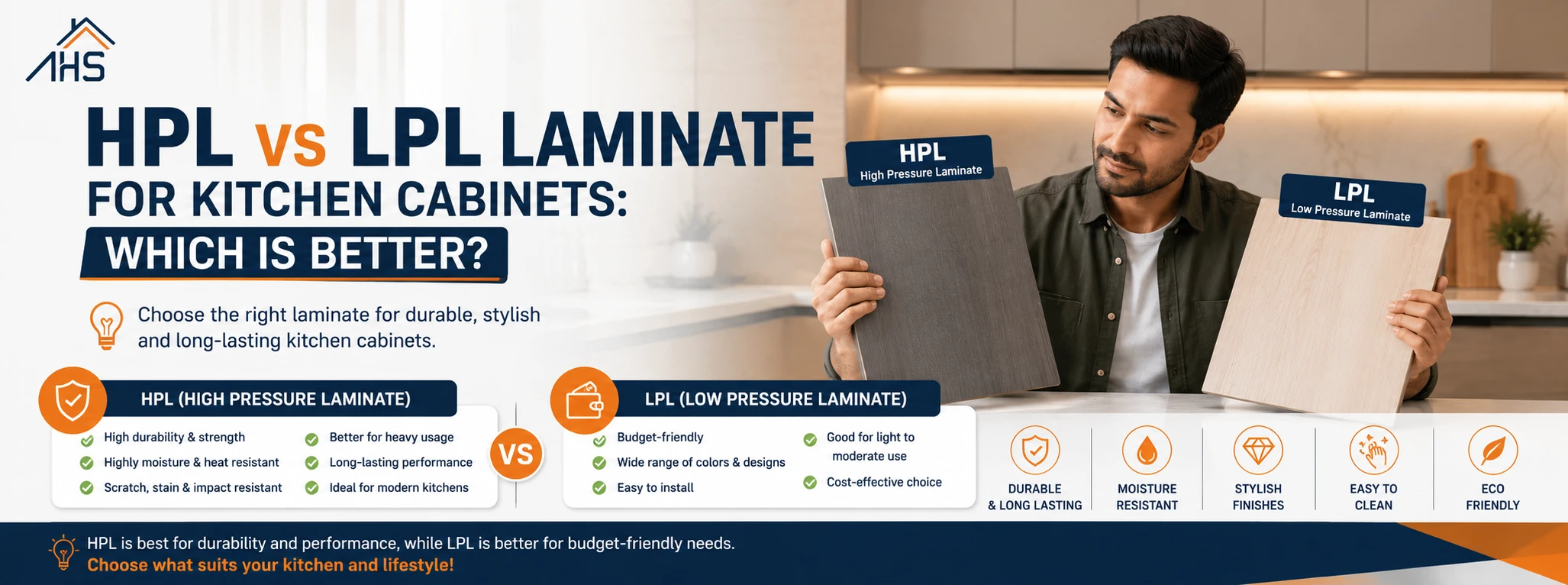
HPL vs LPL Laminate for Kitchen Cabinets: Which Is Better?
HPL vs LPL laminate for kitchen cabinets is an important comparison when planning a modular or custom
kitchen. Both materials offer attractive and easy-to-maintain surfaces, but they differ in construction, durability,
installation, cost, and ideal applications.
Quick answer: For kitchen surfaces that experience frequent handling, impact, abrasion, and demanding
everyday use, HPL (High-Pressure Laminate) is generally the better choice. LPL (Low-Pressure
Laminate) can be a practical and economical option for suitable cabinet panels and lower-wear applications.
However, the right choice depends on more than just price. You should also consider the cabinet substrate, moisture
exposure, expected usage, edge treatment, finish, installation quality, and the manufacturer’s product specifications.
If you are still deciding which laminate is right for your kitchen, read our detailed guide on Best Laminate for Kitchen
Cabinets for more information on finishes, durability, and selection.
HPL vs LPL Laminate: Quick Comparison
| Feature | HPL | LPL |
|---|---|---|
| Full Form | High-Pressure Laminate | Low-Pressure Laminate |
| Manufacturing | Multiple layers pressed under high pressure and heat | Decorative layer fused directly to a suitable substrate |
| Durability | Generally higher | Generally moderate |
| Impact Resistance | Generally higher | Suitable for normal use |
| Wear Resistance | Suitable for high-wear applications | Suitable for lower-wear applications |
| Moisture Performance | Good when properly specified and installed | Depends on the board and installation |
| Design Options | Wide range of colours, textures and finishes | Wide range of decorative finishes |
| Installation | Bonded to a suitable substrate | Usually supplied as a factory-finished board |
| Cost | Generally higher | Generally more economical |
| Best For | High-use and demanding surfaces | Suitable cabinet and furniture applications |
Simple recommendation: Choose HPL when durability and resistance to demanding everyday use are your
main priorities. Choose LPL when you need an economical, factory-finished decorative panel for an application where
extreme surface durability is not necessary.
What Is HPL Laminate?
HPL stands for High-Pressure Laminate. It is a decorative surfacing material manufactured by pressing
multiple layers of resin-treated kraft paper, decorative paper, and a protective overlay under high pressure and
temperature.
This manufacturing process creates a dense and durable laminate sheet that can be bonded to suitable substrates such as
plywood, MDF, particleboard, and other compatible boards.
HPL is commonly used for kitchen cabinets, furniture, countertops, wall panels, doors, and other surfaces where regular
wear and handling are expected.
Benefits of HPL for Kitchen Cabinets
- High durability: Suitable for frequently used kitchen surfaces.
- Good impact resistance: The multi-layer construction provides a robust decorative surface.
- Wear resistance: Suitable for cabinet shutters and other high-use areas.
- Wide design selection: Available in matte, gloss, wood, stone, metallic, and textured finishes.
- Good moisture performance: Can perform well in kitchen environments when properly selected,
sealed, and installed. - Flexible application: Available as separate sheets that can be bonded to a selected substrate.
For kitchens where cabinet shutters and surfaces experience frequent handling, HPL is generally a practical choice
because of its durability and wide range of available finishes.
What Is LPL Laminate?
LPL stands for Low-Pressure Laminate. It is commonly associated with decorative or melamine-faced
boards in which a decorative paper layer is fused directly onto a suitable substrate such as MDF or particleboard during
manufacturing.
Unlike conventional HPL, LPL is generally supplied as a finished decorative board rather than as a separate laminate
sheet that needs to be bonded to the board during fabrication.
Benefits of LPL for Kitchen Cabinets
- Cost-effective: Can be more economical for suitable applications.
- Factory-finished: The decorative surface is already integrated with the board.
- Consistent appearance: Provides a uniform finish across cabinet panels.
- Wide design selection: Available in colours, wood-inspired patterns, textures, and other
decorative finishes. - Practical for suitable applications: Useful where extreme impact and abrasion resistance are
not required. - Efficient fabrication: The finished panel can simplify certain cabinet manufacturing processes.
LPL should not automatically be considered a low-quality material. It simply has a different construction and is
generally more appropriate for applications where the additional performance of HPL may not be necessary.
What Is the Main Difference Between HPL and LPL?
The biggest difference between HPL and LPL is their manufacturing process and construction.
HPL is manufactured as a separate laminate sheet using multiple layers of resin-treated paper that are pressed together
under high pressure and heat. The finished laminate sheet is then bonded to an appropriate substrate.
LPL generally consists of a decorative paper layer that is fused directly onto a suitable substrate during the
manufacturing process.
Because HPL has a reinforced multi-layer construction, it generally offers greater durability and impact resistance. LPL
provides a simpler and more economical decorative panel solution for suitable applications.
HPL vs LPL for Kitchen Cabinets: Detailed Comparison
| Feature | HPL | LPL |
|---|---|---|
| Manufacturing Process | Multiple layers pressed under high pressure and heat | Decorative layer fused directly to the substrate |
| Construction | Separate laminate sheet | Integrated decorative board surface |
| Durability | Generally higher | Generally moderate |
| Impact Resistance | Generally higher | Suitable for normal use |
| Wear Resistance | Suitable for higher-wear applications | Suitable for lower-wear applications |
| Moisture Performance | Good when properly specified and installed | Depends on board, edges, joints, and installation |
| Installation | Requires bonding to a suitable substrate | Usually supplied already bonded to the substrate |
| Design Flexibility | Very high | High |
| Maintenance | Generally easy with proper care | Generally easy with proper care |
| Cost | Generally higher | Generally lower |
Which Is More Durable: HPL or LPL?
If durability is the main consideration, HPL generally has an advantage over LPL.
The multi-layer construction of HPL creates a robust decorative surface that is well suited to applications involving
regular impact, abrasion, handling, and everyday wear.
LPL can still perform effectively when used in the right application, but it is generally more appropriate for areas
where extreme impact and abrasion resistance are not required.
This makes HPL a strong choice for demanding kitchen surfaces, while suitable LPL panels can be considered for
lower-wear cabinet applications.
Which Is Better for Kitchen Cabinets: HPL or LPL?
There is no need to use exactly the same material throughout every part of a kitchen.
HPL can be a better choice for kitchen shutters and surfaces that experience frequent handling, impact, and
higher wear.
LPL can be considered for suitable cabinet interiors, panels, shelving, and other areas where expected wear is lower and
budget efficiency is important.
The final decision should also consider the substrate, moisture exposure, edge treatment, hardware, fabrication quality,
and manufacturer’s recommendations.
Is HPL Better for Indian Kitchens?
Indian kitchens can experience frequent cooking, steam, oil splashes, spices, heat, moisture, and regular cleaning.
Because of these conditions, surface materials should be selected according to the actual environment and level of use.
For demanding kitchen applications, good-quality HPL is generally a practical option because of its
durability and resistance characteristics.
However, laminate alone does not make a cabinet completely waterproof or heatproof. Proper cabinet construction,
suitable substrate selection, edge finishing, sealing, and installation are equally important.
For a broader guide, read our article on Best Laminates for Indian
Kitchens to understand how heat, moisture, stains, finishes, and everyday usage should influence
your choice.
HPL vs LPL for Kitchen Shutters
Kitchen shutters are opened, closed, touched, and cleaned multiple times every day. They can also be exposed to
cooking-related moisture, oil, dust, and accidental impact.
For this reason, HPL is generally the more robust option for high-use kitchen shutters.
However, a suitable LPL-faced board can also work for kitchen cabinetry when the product is specifically designed for
the intended application and the kitchen environment is properly managed.
Choose HPL for Kitchen Shutters When:
- The kitchen experiences heavy daily use.
- You want a highly durable decorative surface.
- The shutters receive frequent handling.
- Higher resistance to impact and wear is important.
- You want flexibility in selecting the laminate and substrate separately.
Consider LPL When:
- Budget efficiency is important.
- The selected LPL board is specifically suitable for cabinetry.
- The application has moderate wear.
- You prefer a factory-finished panel system.
HPL vs LPL for Kitchen Cabinet Interiors
Cabinet interiors generally experience different conditions compared with exterior shutters.
For suitable cabinet interiors, shelving, and lower-wear areas, LPL or melamine-faced boards can be a practical option
when the selected product is designed for the intended use.
This can also help you allocate your kitchen budget more efficiently by using higher-performance materials in areas
where they provide the most benefit.
Can LPL Be Used in Kitchen Cabinets?
Yes, LPL can be used in suitable kitchen cabinet applications.
The important point is that not every LPL product should automatically be considered suitable for every kitchen
environment.
Before selecting LPL, check the manufacturer’s specifications for intended application, moisture exposure, cleaning
requirements, substrate compatibility, and installation conditions.
LPL can be particularly practical for cabinet interiors, shelving, and other suitable applications where extreme impact
resistance is not required.
Can HPL Be Used for Kitchen Countertops?
Yes. HPL is commonly used for countertops and other higher-wear horizontal surfaces when the selected product is
specifically rated for the application.
However, HPL should not be treated as completely heatproof or waterproof. Hot cookware, standing water, exposed edges,
poor sealing, and incorrect installation can still damage the countertop system.
Always follow the manufacturer’s recommendations, particularly around gas burners, hobs, ovens, and other heat sources.
Which Is More Resistant to Water: HPL or LPL?
Neither HPL nor LPL should automatically be described as completely waterproof.
HPL can provide a moisture-resistant decorative surface when correctly specified and installed. However, moisture can
still reach the underlying substrate through exposed edges, joints, damaged surfaces, or poor sealing.
With LPL, performance also depends significantly on the board underneath and the protection provided to edges and
joints.
For sink cabinets and other moisture-prone areas, pay particular attention to:
- Substrate selection
- Edge finishing
- Joint protection
- Sealing
- Proper installation
Which Is Better for Heat Resistance: HPL or LPL?
HPL generally has an advantage for applications where greater resistance to demanding everyday conditions is required.
However, no decorative laminate should be considered a replacement for proper safety clearance around gas burners,
ovens, hobs, or other heat sources.
Always check the technical specifications of the particular laminate before installing it close to a heat source.
HPL vs LPL: Which Is More Affordable?
LPL is generally more economical than HPL, although the final installed cost depends on the product,
substrate, thickness, design, brand, fabrication, hardware, and installation.
HPL is supplied as a separate laminate sheet that needs to be bonded to a suitable substrate, which can add fabrication
and material costs.
LPL or melamine-faced boards are manufactured as finished panels, which can simplify production and may reduce overall
project costs for suitable applications.
HPL vs LPL: Which Has Better Design Options?
Both HPL and LPL are available in a wide variety of decorative designs and finishes.
Depending on the manufacturer and collection, you can find:
- Solid colours
- Matte finishes
- Gloss finishes
- Wood-grain finishes
- Stone-inspired designs
- Textured surfaces
- Metallic effects
- Decorative patterns
/blog
Therefore, design alone should not determine whether you choose HPL or LPL. Performance, application, maintenance, and
budget should also be considered.
HPL vs LPL: Which Is Easier to Maintain?
Both surfaces can be relatively easy to maintain when correctly selected and when the manufacturer’s cleaning
instructions are followed.
The specific finish can have a greater effect on visible maintenance than whether the surface is HPL or LPL.
For example, dark glossy finishes may show fingerprints more clearly, while matte and anti-fingerprint finishes can make
everyday marks less noticeable.
Basic Laminate Maintenance Tips
- Clean spills as soon as reasonably possible.
- Use a soft, non-abrasive cloth.
- Follow the manufacturer’s cleaning recommendations.
- Avoid abrasive scrubbers.
- Avoid harsh chemicals unless specifically recommended.
- Do not allow standing water to remain around edges and joints.
- Pay extra attention to cabinets near the sink.
HPL vs LPL for a Budget Kitchen
If you are designing a kitchen on a budget, you do not necessarily need to use the same surface material everywhere.
A better approach is to identify the areas that experience the highest wear and allocate your budget accordingly.
- High-use surfaces: Consider HPL where greater durability provides a benefit.
- Cabinet interiors: Suitable LPL or melamine-faced panels may be considered where appropriate.
- Lower-wear areas: A cost-effective decorative panel can make sense if it meets the application
requirements. - Moisture-prone areas: Prioritise proper substrate selection, edge finishing, and sealing.
This application-based approach can provide a better balance between performance and budget than simply choosing HPL or
LPL for the entire kitchen.
Common Mistakes When Choosing HPL or LPL
1. Choosing Only by Price
The cheapest option is not always the best value. Consider durability, application, installation quality, maintenance,
and expected service life.
2. Assuming HPL Is Completely Waterproof
HPL can provide a moisture-resistant decorative surface, but water can still reach the substrate through exposed edges,
joints, or damaged areas.
3. Treating Every LPL Product as the Same
LPL products can differ in board quality, surface technology, finish, thickness, and intended application. Always check
the manufacturer’s specifications.
4. Ignoring the Substrate
The decorative surface is only one component of a kitchen cabinet. The board underneath, adhesive where applicable, edge
treatment, hardware, and construction quality all influence the final result.
5. Using the Wrong Material for High-Wear Areas
Where a surface experiences frequent impact, abrasion, or demanding use, the additional durability of HPL may justify
the higher cost.
6. Ignoring Edge Finishing
Edges are particularly important in kitchens because they can be exposed to moisture and physical impact. Proper edge
finishing helps protect the overall cabinet system.
HPL vs LPL: What Should You Choose for Your Kitchen?
| Your Requirement | Recommended Direction |
|---|---|
| Heavy daily kitchen use | HPL |
| Higher impact and wear resistance | HPL |
| High-use cabinet shutters | HPL |
| Budget-conscious suitable cabinetry | LPL may be suitable |
| Factory-finished cabinet panels | LPL may be suitable |
| Cabinet interiors and lower-wear areas | LPL may be suitable |
| Maximum application flexibility | HPL |
HPL vs LPL: Final Verdict
HPL is generally the better choice when durability, impact resistance, and demanding everyday performance are
the main priorities.
LPL can be the better-value option when you need a decorative, factory-finished panel for a suitable lower-wear
application and want to control the overall project budget.
So, the answer to “HPL or LPL for kitchen cabinets?” is not that one material is always better than the
other.
The smarter approach is to choose the material according to the application.
For demanding surfaces: HPL.
For suitable lower-wear cabinet applications: LPL can be practical.
Remember that the final performance of your kitchen depends on more than the laminate. Substrate quality, fabrication,
edge finishing, moisture protection, hardware, and installation all play an important role.
Good surface material + suitable substrate + proper edge finishing + quality installation is the right
formula for a durable and attractive kitchen.
Frequently Asked Questions About HPL vs LPL
Is HPL better than LPL for kitchen cabinets?
HPL is generally the stronger option for higher-wear kitchen applications because it offers greater durability and
impact resistance. LPL can be suitable for cabinet panels and other lower-wear applications when the product is
specified for that use.
What is the difference between HPL and LPL?
HPL is a separate laminate sheet made by pressing multiple layers under high pressure and heat. LPL generally involves a
decorative layer fused directly to a suitable substrate during manufacturing. This difference affects construction,
durability, installation, and cost.
Is LPL good for kitchen cabinets?
Yes, LPL can be suitable for kitchen cabinetry when the selected product is designed for the intended application. It
can be particularly useful for cabinet interiors, shelving, and other lower-wear areas.
Is HPL good for kitchen cabinets?
Yes. HPL is a practical option for demanding kitchen applications because of its durability, impact resistance, wear
resistance, and wide range of decorative finishes.
Which is more durable, HPL or LPL?
HPL is generally more durable and better suited to higher-wear applications. LPL is suitable for applications where the
additional performance of HPL may not be necessary.
Is HPL waterproof?
No laminate should automatically be considered completely waterproof. HPL can provide a moisture-resistant decorative
surface, but proper substrate selection, edge finishing, sealing, and installation are essential, particularly around
sinks.
Is LPL cheaper than HPL?
LPL is generally more economical because its decorative surface is integrated with the board during manufacturing. HPL
is supplied as a separate sheet and requires bonding to a substrate. Actual project costs vary depending on the product,
board, design, fabrication, and installation.
Which is better for kitchen countertops, HPL or LPL?
HPL is generally the preferred option for demanding countertop applications because of its durability and resistance to
impact and wear. Always select a product specifically recommended for countertop use.
Can HPL and LPL be used together in one kitchen?
Yes. Using different materials according to the application can be a practical approach. HPL can be specified for
higher-wear surfaces, while suitable LPL panels can be used in lower-wear areas.
Which is better for an Indian kitchen, HPL or LPL?
For demanding Indian kitchen applications involving frequent cooking and regular use, HPL is generally a sensible
choice. However, suitable LPL can also be used for appropriate cabinet applications. Always check the product
specifications and installation requirements.
Final Takeaway
When comparing HPL vs LPL laminate for kitchen cabinets, don’t choose simply because one sounds
stronger or the other sounds cheaper.
HPL is generally the better choice for demanding, high-wear applications where durability and impact
resistance matter.
LPL can be a smart and economical choice for suitable cabinet panels and lower-wear applications where
extreme surface performance is not required.
The best kitchen is not necessarily the one that uses the most expensive material everywhere. It is the one where each
material is selected according to how the surface will actually be used.
Choose HPL where performance matters most, choose suitable LPL where cost efficiency makes sense, and always pay
attention to the substrate, edges, moisture protection, and installation quality.
Why Choose Aggarwal Home Studio for Laminates?
Choosing the right laminate is only one part of creating a reliable and stylish kitchen. The quality of the board,
laminate, fabrication, edge finishing, hardware, and installation all contribute to the final result.
Aggarwal Home Studio is a home interior material
supplier in Pathankot, Punjab, offering laminates, plywood, veneers, architectural hardware, and other interior
materials for kitchens, wardrobes, furniture, and residential and commercial interior projects.
Whether you need a durable HPL surface for kitchen shutters or a suitable decorative LPL panel for lower-wear
applications, our team can help you compare available materials according to your design, usage, and project
requirements.
You can also explore our home interior materials and laminate solutions to understand the range of
products available for your project.
Need Help Choosing HPL or LPL?
Still confused about which laminate is suitable for your kitchen cabinets?
Don’t choose only on the basis of price or appearance. Share your kitchen requirements, preferred
finish, budget, and application with Aggarwal Home Studio and get guidance on suitable laminate and interior materials.
Contact Aggarwal Home Studio to discuss
your project, request product samples, compare suitable options, or ask for product datasheets and technical information
before making your final decision.
Choose the right material for the right application and build a kitchen that looks beautiful, performs reliably,
and lasts for years.
Leave a Reply