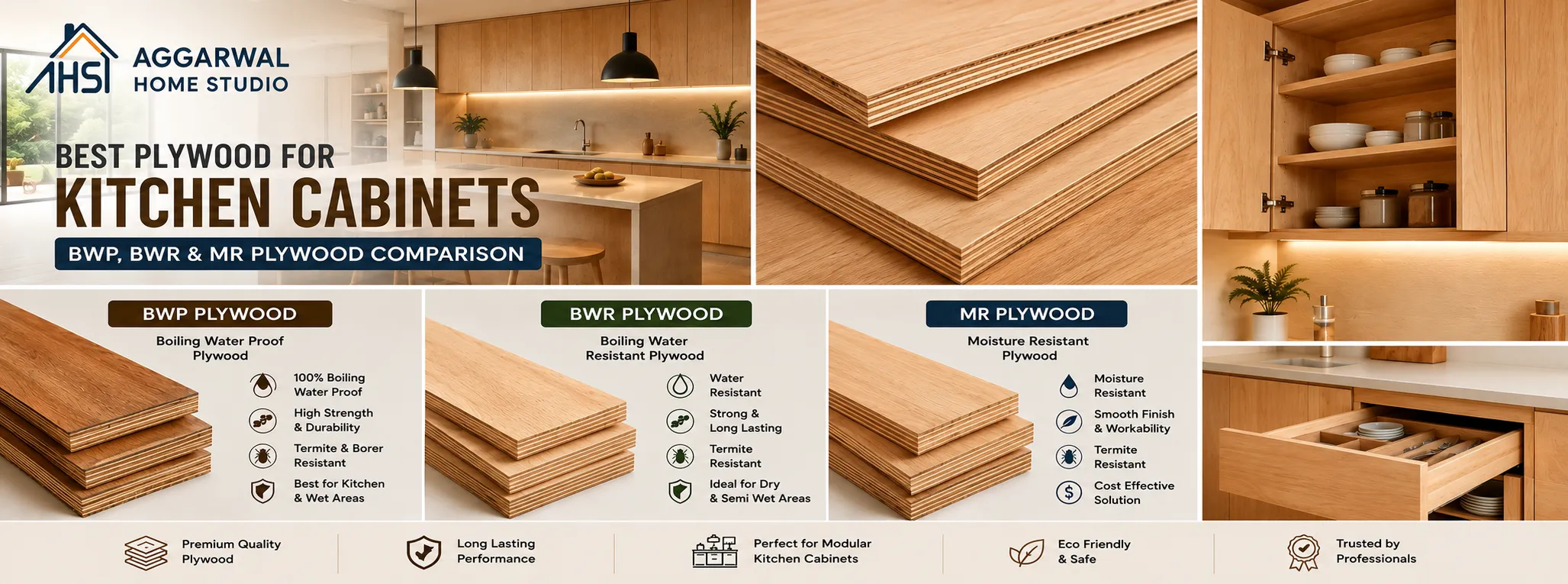
Best Plywood for Kitchen Cabinets: Types, Grades, Thickness & How to Choose
Choosing the best plywood for kitchen cabinets is one of the most important decisions when planning a modular or custom kitchen. Kitchen cabinets are exposed to moisture, steam, heat, spills and frequent cleaning, so the plywood needs to be strong, stable and suitable for the environment.
For most Indian kitchens, BWP/BWR-grade plywood is generally a better choice than ordinary MR plywood, especially for areas exposed to moisture. The exact grade should depend on the cabinet location, expected water exposure and your budget.
In this guide, we explain the best quality plywood for kitchen, different plywood types, recommended thicknesses, what plywood is used for modular kitchens, and how to check plywood quality before buying.
Quick Answer: What Is the Best Plywood for Kitchen Cabinets?
If you want a simple answer, choose a good-quality BWP or BWR plywood that complies with the applicable BIS standard, depending on where it will be used.
For areas such as the under-sink cabinet and other high-moisture zones, a higher water-resistant grade such as BWP can provide additional protection. For relatively dry kitchen cabinets, a good BWR-grade plywood can be a practical option.
More importantly, don’t choose plywood only by the words “waterproof” or “marine” printed on the product. Check the BIS marking, grade, thickness, manufacturer details and warranty before purchasing.
What Makes Good Plywood for Kitchen Cabinets?
A good kitchen plywood should have several important characteristics:
- Good resistance to moisture
- Strong internal bonding
- Consistent thickness
- Minimal core gaps or voids
- Good screw-holding strength
- Resistance to warping and delamination
- Suitable surface quality for laminates or other finishes
- Proper certification and traceable manufacturer information
The kitchen environment is different from a bedroom or living room. Steam from cooking, water around the sink and
regular cleaning can expose cabinets to moisture repeatedly.
That is why choosing the right plywood grade matters.
Types of Plywood for Kitchen Cabinets
There are several types of plywood available for kitchen cabinets. The most common options include MR, BWR and BWP grades.
1. BWP Plywood
BWP stands for Boiling Water Proof plywood.
It is designed for applications where plywood may experience significant moisture exposure. This makes it particularly useful for kitchen areas where water contact is more likely.
BWP can be considered for:
- Under-sink cabinets
- Base cabinets
- Cabinets near plumbing
- Utility areas
- Other moisture-prone parts of a kitchen
However, always check the actual product specification and applicable BIS certification instead of relying only on the
grade name.
2. BWR Plywood
BWR means Boiling Water Resistant.
It offers better resistance to moisture than ordinary MR plywood and is commonly considered for interior applications where occasional moisture exposure is expected.
BWR can be suitable for:
- Kitchen cabinet carcasses
- Shelves
- Storage units
- Relatively dry sections of a modular kitchen
For a budget-conscious kitchen, using a good BWR plywood in suitable locations can help balance performance and cost.
3. MR Plywood
MR means Moisture Resistant.
MR plywood is commonly used for indoor furniture, but it should not automatically be treated as the best choice for
every kitchen application.
It can be considered for relatively dry areas where direct or repeated water exposure is unlikely. For cabinets around
sinks and other wet zones, a more water-resistant grade is generally preferable.
BWP vs BWR vs MR: Which Is Best for a Kitchen?
| Plywood Grade | Moisture Resistance | Suitable Kitchen Use | Budget |
|---|---|---|---|
| MR | Basic | Dry areas | Low |
| BWR | Better | General kitchen applications | Medium |
| BWP | Higher | Wet and moisture-prone areas | High |
The “best” option is therefore not necessarily the most expensive plywood everywhere.
A smarter approach is to match the plywood grade to the location of the cabinet.
For example, you may want stronger moisture protection under the sink while using an appropriate lower-cost grade in a dry storage section.
What Plywood Is Used for Modular Kitchen Cabinets?
The plywood used for a modular kitchen should be selected according to the component.
A typical modular kitchen can include:
- Base cabinet carcass
- Wall cabinet carcass
- Shelves
- Shutters
- Drawer boxes
- Back panels
- Under-sink units
For the main cabinet carcass, many homeowners choose BWR or BWP plywood depending on moisture exposure and budget.
For wet areas such as the sink cabinet, choosing a higher water-resistant plywood can provide additional protection.
For shutters, the choice may also depend on the finish, size, design and hardware. Plywood is not the only material used for shutters; MDF, HDHMR and other engineered boards may also be suitable for particular designs.
Therefore, asking only “which plywood is best?” is not enough. The better question is:
Which material and grade is best for each part of my kitchen?
Best Plywood Thickness for Kitchen Cabinets
Plywood thickness is an important factor when choosing material for kitchen cabinets. The right thickness depends on the cabinet component, load, span, and construction method.
For most kitchen cabinet carcasses and other main structural components, 18–19 mm plywood is a commonly preferred choice because it provides good strength and stability.
Common plywood thicknesses used in kitchen furniture include:
- 18–19 mm: Commonly used for main carcass components, shutters, and other heavy-duty applications.
- 12 mm: Suitable for selected partitions, shelves, and other components where the design and load requirements allow it.
- 6–9 mm: Often used for cabinet backs, drawer bottoms, or other non-structural components.
However, thicker plywood is not necessarily better. The appropriate thickness should be selected based on the cabinet’s dimensions, expected load, span, construction method, and hardware. The plywood’s grade and manufacturing quality are also important factors in determining its performance.
For most standard kitchen cabinet structures, 18–19 mm plywood is a practical choice, while thinner sheets can be used for specific components where appropriate.
Calibrated Plywood for Modular Kitchens
If you are getting a factory-made modular kitchen, calibrated plywood can be worth considering.
Calibrated plywood is manufactured to provide more consistent thickness, which can help during CNC cutting, assembly and
installation.
Potential benefits include:
- More accurate cabinet construction
- Better alignment
- Consistent panel dimensions
- Easier installation
- More uniform laminate finishing
However, calibration alone does not make plywood waterproof or automatically superior. Grade, core quality, bonding and
manufacturing quality still matter.
Best Quality Plywood for Kitchen: What Should You Check?
Before buying plywood, don’t rely only on the brand name.
Check these points:
1. Check the BIS Marking
Look for the applicable BIS certification and product details.
For plywood covered under IS 303, the current BIS documentation includes grades such as MR, BWR and BWP.
2. Check the Actual Thickness
If you are purchasing 18 or 19 mm plywood, verify the actual thickness rather than relying only on the salesperson’s
description.
3. Inspect the Edges
Look at the plywood edge carefully.
A good-quality sheet should have reasonably uniform layers without obvious large gaps, voids or poorly bonded sections.
4. Look for Warping
Place the sheet on a reasonably flat surface and check whether it is excessively bent or twisted.
5. Ask About Warranty
A manufacturer’s warranty can provide useful information about the product and its intended application.
Always read what the warranty actually covers.
6. Buy From an Authorised Dealer
Buying from a reliable dealer reduces the risk of receiving incorrectly labelled, damaged or questionable material.
Is Marine Plywood Necessary for Every Kitchen?
Not necessarily.
“Marine plywood” is often used as a premium term in kitchen discussions, but homeowners should distinguish between
marketing terminology and the actual product standard.
If a salesperson says a plywood is “marine grade” or “waterproof,” ask for:
- Applicable BIS standard
- Grade
- Product specification
- Thickness
- Manufacturer details
- Warranty
The right product depends on the actual kitchen environment rather than the label alone.
Best Plywood for Kitchen Cabinets: BWP or BWR?
For many homeowners, this is the most important comparison.
Choose BWP when:
- The cabinet is close to a sink
- There is a higher risk of water exposure
- You want additional moisture protection
- Long-term durability is a priority
Consider BWR when:
- The cabinet is in a comparatively dry area
- Moisture exposure is moderate
- You want to control the overall project cost
- The product meets the required specification
The final decision should also consider the quality of manufacturing and installation.
Why Plywood Quality Alone Doesn’t Make a Kitchen Durable
Even the best plywood can develop problems if the kitchen is poorly designed or installed.
Pay attention to:
Edge Protection
Exposed plywood edges should be properly sealed or finished. Water can enter through exposed edges even when the plywood itself has good moisture resistance.
Sink Area
The cabinet below the sink deserves special attention because plumbing leaks and water spills can cause repeated
moisture exposure.
Proper Installation
Cabinets should be installed correctly, with suitable support, alignment and protection from floor moisture.
Good Hardware
Hinges, drawer channels and fasteners also affect the overall life of a kitchen.
In other words:
Good plywood + good design + good installation = a more durable kitchen.
Common Mistakes to Avoid When Buying Kitchen Plywood
Choosing the right plywood is essential for durable and long-lasting kitchen cabinets. Avoid common mistakes such as choosing plywood based only on price, ignoring water resistance, or selecting the wrong thickness and grade. Learn about the common mistakes to avoid when buying kitchen plywood before making your purchase.
Mistake 1: Choosing the Cheapest Plywood
The cheapest sheet may reduce the initial cost but can increase repair and replacement costs later.
Mistake 2: Buying Only by Brand Name
A well-known brand is not a substitute for checking the actual grade, specification and product details.
Mistake 3: Using the Same Grade Everywhere
Different areas of a kitchen experience different levels of moisture. A single material specification may not always be
the most cost-effective solution.
Mistake 4: Ignoring the Edges
Even water-resistant plywood needs proper edge protection and installation.
Mistake 5: Not Checking the Bill
Make sure your quotation clearly mentions:
- Plywood brand
- Grade
- Applicable standard
- Thickness
- Quantity
- Warranty
This makes it easier to verify what has actually been supplied.
How Much Does Good Kitchen Plywood Cost?
Plywood prices vary considerably based on:
- Grade
- Brand
- Thickness
- Size
- Core quality
- Calibration
- Location
- Dealer
- Market conditions
Therefore, instead of choosing plywood only because it has the lowest price per square foot, compare the
specification and quality at the same thickness.
A ₹/sq ft comparison is useful only when you are comparing like-for-like products.
Best Plywood for Kitchen Cabinets: Our Recommendation
If you are building a kitchen in India, use this simple approach:
For moisture-prone areas:
Choose a suitable BWP-grade plywood from a reputable manufacturer and verify the applicable certification.
For general kitchen cabinets:
A good-quality BWR or BWP plywood can be considered depending on your budget and moisture exposure.
For dry areas:
An appropriate MR product may be sufficient in some applications, provided it is suitable for the specific location.
For a premium modular kitchen:
Consider calibrated plywood where dimensional consistency and factory manufacturing are important.
The key is not simply buying the most expensive plywood. It is about choosing the right plywood for the right
part of the kitchen.
Frequently Asked Questions
Which plywood is best for kitchen cabinets?
For most Indian kitchens, good-quality BWR or BWP plywood is commonly considered, with BWP being particularly suitable for areas exposed to higher moisture. The exact choice should depend on the cabinet location, product specification and budget.
What is the best quality plywood for kitchen?
The best quality plywood for a kitchen should have suitable moisture resistance, strong bonding, consistent thickness, good core construction and verified certification. For moisture-prone areas, BWP is generally a strong choice.
What plywood is used for modular kitchens?
BWR and BWP plywood are commonly considered for modular kitchen cabinets. Calibrated plywood can also be useful for factory-made modular kitchens because of its dimensional consistency.
Is BWR plywood good for kitchen cabinets?
Yes. Good-quality BWR plywood can be suitable for many kitchen cabinet applications, particularly where moisture
exposure is moderate. For areas with a higher risk of water exposure, BWP may be a better choice.
Is MR plywood good for kitchen cabinets?
MR plywood can be suitable for relatively dry indoor applications, but it is generally not the first choice for areas
with repeated water exposure, such as under-sink cabinets.
What thickness plywood is best for kitchen cabinets?
18–19 mm plywood is commonly considered for major cabinet components, while thinner sheets can be used for selected parts depending on the design and construction method. The required thickness should be specified by the cabinet manufacturer or designer according to load and application.
Is calibrated plywood better for modular kitchens?
Calibrated plywood can be advantageous for modular kitchens because its more consistent thickness can improve machining, alignment and assembly. However, calibration does not replace the need for good plywood grade and core quality.
How can I check plywood quality before buying?
Check the applicable BIS marking, grade, actual thickness, edge construction, surface condition, warping, manufacturer details and warranty. Buying from an authorised or reputable dealer is also recommended.
Final Verdict
The best plywood for kitchen cabinets is not simply the most expensive sheet available. For a durable kitchen, focus on the right combination of plywood grade, core quality, thickness, moisture resistance and proper
installation.
For a long-lasting kitchen, keep these four factors in mind:
- Correct plywood grade
- Good manufacturing and core quality
- Appropriate thickness
- Proper installation and edge protection
For moisture-prone areas, a suitable BWP-grade plywood can provide greater protection, while good-quality BWR plywood can be a practical choice for many general kitchen applications. Before buying, always verify the applicable BIS certification, grade and manufacturer specifications rather than choosing solely on the words “waterproof” or “marine.”
A little research before construction can help prevent problems such as swelling, delamination and warping, while also reducing the chances of expensive cabinet repairs later.
Looking for reliable plywood for your next kitchen or furniture project? Aggarwal Home Studio is a plywood manufacturer, wholesaler and supplier in India, offering quality plywood solutions for kitchens, modular furniture, cabinets and other interior applications.
Upgrade your home with Aggarwal Home Studio — your reliable plywood manufacturer, wholesale supplier and plywood
partner in India.
 Need expert guidance? Contact Aggarwal Home Studio today.
 Visit our store for architectural hardware and interior solutions. Find Location
Leave a Reply